


World Mental Health Day lands on October 10 every year, and for many people the hard part isn’t caring about it. It’s finding the right words to post.
This page gives you original World Mental Health Day captions for Instagram, written for different situations: sharing your own story, checking on a friend, posting for a team or a classroom, or saying something small when you’re not ready to say much.
You’ll also find the official 2026 theme, a simple three-part check for writing your own caption, and a way to keep a hopeful post from sounding dismissive. Copy anything you like, then change the details until it sounds like you.
| Key Takeaways • World Mental Health Day is fixed on October 10 each year, and in 2026 it fell on a Saturday. The 2026 theme was “Lived Experiences Heard: Real Voices, Real Change.” • The strongest mental health captions say one true thing, show one specific detail, and point toward support. • Captions below are grouped by situation (personal story, friend, workplace, classroom, brand), so you can match the words to who you are and how open you want to be. • Every caption is original and works year-round, not only on October 10. |
Best World Mental Health Day Captions to Copy and Post Today
If you only have a minute, start here. Each pick has a different tone, so you can choose the one that matches your post.
1. Honest: Today I’m posting the thing I usually keep in drafts: my brain needs maintenance too, and I’m finally treating it that way.
2. Awareness: Mental health isn’t a mood or a phase. It’s health. Happy to say it loudly on October 10 and quietly the other 364 days.
3. Hopeful: Some days the win is getting out of bed. Some days it’s asking for help. Both count.
4. For a friend: If you’ve been quiet lately, I noticed. No pressure to explain. Text me back whenever you can.
5. Self-care: Rest isn’t a reward for finishing everything. It’s part of how anything gets finished.
6. Advocacy: Care shouldn’t depend on your income, your address, or how well you can explain your pain. Mental health support is a basic need.
7. Short: Check in. Then check in again.
8. Healing: Healing didn’t look like a straight line. It looked like a lot of ordinary Tuesdays that I got through.
9. Theme-inspired: The people living it know what needs to change. Real voices, real change.
10. Workplace: Being “fine” at work isn’t the same as being well. Ask your team how they’re really doing, and make room for the honest answer.
World Mental Health Day 2026: Date, Theme and What It Means for Your Caption
Knowing the day’s purpose helps you write something that feels current rather than recycled. The date never changes: October 10. The 2026 observance fell on Saturday, October 10, and the next one is Sunday, October 10, 2027.
The Global Theme: “Lived Experiences Heard: Real Voices, Real Change”
The World Federation for Mental Health (WFMH) sets the global theme. In its 2026 message, the WFMH said meaningful progress depends on close collaboration with people who have lived experience, and that the focus should move from speaking for people to listening and working with them. It also linked the theme to the WHO’s work on moving toward community-based mental health services.
For captions, this means the most on-theme posts are about listening, participation, and community, not just “be positive.” A caption like #9 above, or the theme-inspired set later in this article, fits this idea.
Why Some Sites Show a Different Theme (Global vs. Local Campaigns)
You may find other 2026 themes online, including workplace-focused, community-focused, and “unequal world” versions. Those conflict with the WFMH’s own message, which uses “Lived Experiences Heard: Real Voices, Real Change.” Some also appear to be recycled from earlier years.
There’s a second source of confusion. Countries often run their own campaigns under the global day. Mental Health Australia, for example, notes that the global theme is set by the WFMH, while its Australian campaign uses the separate theme “Together We Thrive.” If you’re quoting a theme in a post, check wmhdofficial.com first.
The Say–Show–Signpost Check: What Makes a Mental Health Post Land
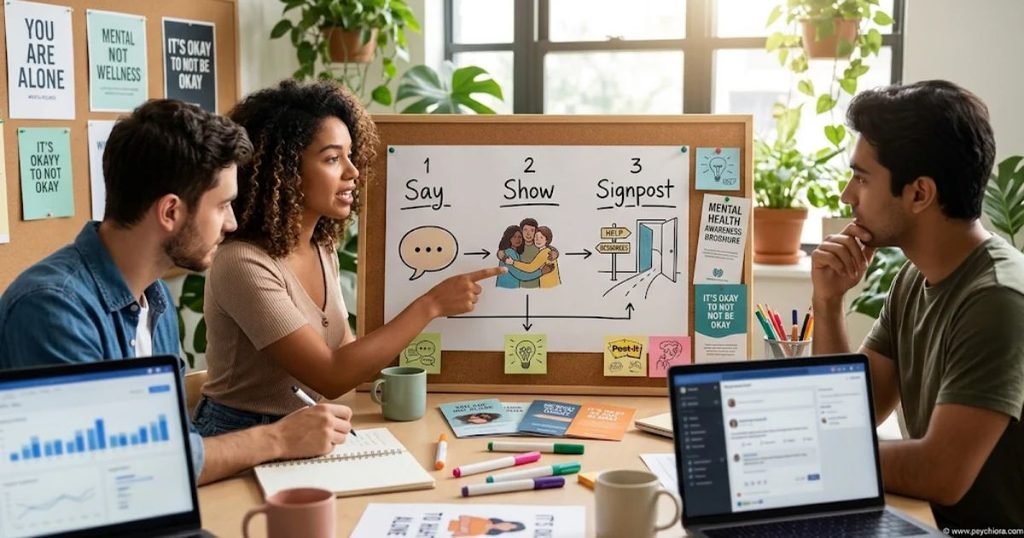
Most forgettable captions fail the same way: they are generic. They could be pasted under any photo on any day. This three-part check, which we call Say–Show–Signpost, helps you avoid that.
• Say: State one true thing in plain words. “I’ve been struggling with sleep this year” is stronger than “mental health is important.”
• Show: Add one specific detail: a habit, a moment, an action. “I started walking after dinner instead of scrolling” gives readers something real.
• Signpost: Point to support or invite a small action: check on a friend, tell one person, find a helpline. You don’t need to be a professional to do this.
You don’t need all three every time. A short caption can do just one. But if you’re writing something longer, the signpost is what turns an awareness post into a useful one. Support lines for several regions are listed at the end of this article.
How to Avoid Toxic Positivity in Your Caption
Cheerful captions are fine. The problem starts when positivity is used to skip over real pain. Counselors explain that toxic positivity denies, minimizes, and invalidates authentic emotions, and can make it harder for people who are struggling to open up.
A few quick swaps:
• Instead of “Good vibes only,” try “All feelings are welcome here.”
• Instead of “Just stay positive,” try “You don’t have to be okay today.”
• Instead of “You’ll get through this,” try “That sounds really hard, and I’m here.”
One expert’s suggested reframe is to replace “You will get through this” with “This sounds really painful.” Acknowledgment usually lands better than reassurance.
Before-and-After Example
Before: Good vibes only! Mental health is a journey 🌈 #WorldMentalHealthDay
After: I stopped pretending I was fine in meetings this year. Saying “I’m struggling this week” out loud made it smaller. If you’re carrying something, tell one person today. #WorldMentalHealthDay
The second version says something true, shows a specific change, and gives the reader a small next step.
Short Mental Health Captions for Instagram
Short captions suit selfies, nature photos, plain text graphics, and Story text. Each one below takes a different angle, so none is a rewording of another.
11. Pause. Breathe. Begin again.
12. Be gentle with yourself today.
13. Your mind deserves the same care as your body.
14. Asking for help is a skill, not a failure.
15. Not okay is allowed.
16. Talk. Listen. Repeat.
17. Small steps still count.
18. Mental health is health. Full stop.
19. Say it out loud, even if your voice shakes.
20. Still here. Still healing.
21. Check on your people, even the ones who seem fine.
22. Therapy is maintenance, not a last resort.
23. You’re allowed to take up space.
24. Listening is a kind of care.
25. Your feelings are information, not weakness.
Mental Health Awareness Captions That Break the Stigma

Awareness captions work best when they challenge a specific myth or assumption. Use them for graphics, carousels, and posts meant to start a conversation.
26. Nobody calls a broken leg dramatic. Mental illness deserves the same seriousness.
27. Stigma tells people to stay quiet. Conversation is how we answer it.
28. You can’t tell who’s struggling by looking. That’s exactly why we ask.
29. Mental health conditions are common, treatable, and nothing to be ashamed of.
30. Saying “I’m in therapy” shouldn’t take courage. Let’s make it ordinary.
31. Words matter. “Crazy” and “psycho” aren’t adjectives for a bad day.
32. Anxiety isn’t being dramatic. Depression isn’t being lazy. Let’s retire both myths.
33. Seeking help is one of the most practical things a person can do for their health.
34. Most of us will meet a mental health challenge at some point, in our own lives or someone else’s. Better to be ready with kindness.
35. Silence protects stigma, not people. Start the conversation.
36. A diagnosis is a description, not a definition.
37. Strong people ask for help too. Strength was never about doing it alone.
38. If this post makes one person feel less alone, it’s done its job.
Positive and Hopeful Mental Health Captions
Hope reads best when it’s modest and specific. These captions stay hopeful without pretending that everything is fine.
39. Hard seasons end. Not always on schedule, but they do.
40. Today I’m choosing small and steady over big and exhausting.
41. Hope isn’t pretending things are fine. It’s believing things can change.
42. Noticing one good moment today counts, even if the rest was heavy.
43. You’ve survived every bad day so far. That’s a record worth respecting.
44. Better days aren’t a myth. Some of mine just took a while to arrive.
45. A walk, a glass of water, a text back. Tiny things, real progress.
46. Progress can be quiet. It still counts.
47. Letting light in doesn’t mean ignoring the dark. Both can be true.
48. Grateful for the people who stayed, and for the version of me who let them.
49. I’m not where I want to be, but I’m not where I was. That’s enough to smile about.
50. Tomorrow doesn’t need a plan. It just needs you to show up.
51. Joy and struggle can sit at the same table. Pull up a chair for both.
Self-Care and Boundaries Captions

Self-care captions land better when they name a real action, such as resting, saying no, or switching off, rather than a bubble bath cliché.
52. Self-care isn’t selfish. It’s maintenance.
53. “No” is a complete sentence, and a form of self-care.
54. Your phone has a flashlight and a Do Not Disturb mode. Use the second one tonight.
55. Boundaries aren’t walls. They’re how I stay able to show up.
56. Sleep, water, sunlight, a real meal. Boring basics, big difference.
57. Unfollowed anything that makes me feel behind. Feed cleaned.
58. Rest first. Productivity can wait.
59. Today’s plan: fewer obligations, more breathing room.
60. Taking a day off before you break is smarter than taking one after.
61. You can love people and still need time alone.
62. Self-care looks different every day. Today it looks like a quiet evening.
63. Take the break you’d give a friend without a second thought.
64. Guard your energy. It’s the one thing you can’t refill by working harder.
Healing and Growth Captions (When Progress Isn’t Linear)
Recovery rarely moves in a straight line. These captions make room for setbacks and slow progress.
65. Healing isn’t linear, and a setback doesn’t erase the progress.
66. Some days I take three steps forward. Some days one back. I’m still moving.
67. I used to think recovery meant never struggling again. Now I think it means knowing what to do when I do.
68. Growth looked like therapy, awkward honesty, and a lot of patience.
69. I’m proud of how far I’ve come, even on the days I can’t see it.
70. Getting better at asking for help is the biggest change I’ve made.
71. Old me survived. New me is learning how to live.
72. It’s okay if healing is slow. Slow still counts as moving.
73. A bad week doesn’t cancel a good year.
74. Therapy didn’t fix me. It gave me tools, and I’m using them.
75. Some wounds need time, some need professional care, and most need both.
76. Looking back at where I started. Thankful I kept going.
Honest “Not Okay” Captions for When Positivity Feels Fake
Not everyone feels upbeat on World Mental Health Day, and that’s allowed. These captions are the honest counterweight to toxic positivity.
77. Not every post has to end on a high note. Some days are just hard.
78. I’m not okay today, and I’m saying so instead of pretending.
79. If today’s heavy for you too, you’re in good company.
80. Smiling in photos doesn’t mean I’m fine. Ask me anyway.
81. No lesson, no silver lining today. Just getting through it.
82. It’s okay to skip the “good vibes” and say it plainly: this is hard.
83. I don’t need fixing today. I need someone to sit with me.
84. Awareness days feel strange when you’re in the middle of it. I’m here anyway, tired but honest.
85. “Okay” is a goal some days, not a baseline.
86. If you’re struggling and the cheerful posts feel fake, this one’s for you. You’re not alone.
87. I’m taking today slowly. Be patient with me.
88. If you’re not okay, please tell someone today. If you’re in danger, call your local emergency number.
Captions Inspired by the 2026 Theme: Lived Experience and Real Voices
The 2026 theme, “Lived Experiences Heard: Real Voices, Real Change,” is about listening to people who live with mental health conditions and letting that shape services and policy. These captions work for people who share their own story and for people who want to amplify others.
89. Nobody understands a struggle like the person living it. Let’s start by listening to them.
90. Real voices, real change. If you’ve lived it, your story belongs in this conversation.
91. Decisions about mental health care should include the people who rely on it.
92. I used to think my story wasn’t worth telling. Now I think the people making policy should hear it.
93. Listening isn’t a pause before giving advice. It’s the work.
94. Speaking for people is easy. Making room for them to speak is harder, and it matters more.
95. Lived experience is expertise. Treat it that way.
96. My recovery had a lot of help in it: people, places, and services that listened. More people deserve that.
97. If you’ve ever felt unheard in a waiting room, this day is for you too.
98. Share your story only if and when you want to. Your voice counts either way.
Captions for Supporting a Friend or Loved One

Not every caption is about you. Some of the most useful posts on October 10 are public nudges that tell someone you’re available. These also work as private message openers.
99. If you’ve been on my mind lately, it’s because you matter to me. No need to reply. Just know I’m here.
100. I’m not great with the right words, but I’m good at showing up. Call me.
101. You don’t have to be okay to hang out with me. Bring the bad day.
102. Checking in on my people today. If that’s you, consider this your check-in.
103. Thank you to the friend who stayed on the phone with me when I couldn’t explain what was wrong.
104. Being there for someone often looks like sitting nearby and saying very little.
105. If someone has told you they’re struggling, thank them for trusting you. Then ask what would help.
106. The best thing a friend ever said to me: “You don’t have to explain it. I believe you.”
107. Not sure what to say to someone who’s hurting? “I’m here” is enough to start.
108. Text the friend you haven’t heard from. Today. Even if all you send is a heart.
Advocacy and Community Captions
These work for posts that push beyond personal feelings toward access, funding, and fairness. They suit carousels, nonprofit pages, and anyone who wants their post to point at a bigger issue.
109. Good mental health care shouldn’t depend on where you live or how much you earn.
110. Waitlists are not a treatment plan. Mental health services need real investment.
111. Communities that make room for connection protect mental health in ways no app can.
112. Housing, work, and income all shape how people feel. Mental health is about systems as well as individuals.
113. Moving care closer to home means more people get help without having to leave their lives behind.
114. Ask your local leaders what they’re doing for mental health. Then ask again.
115. People with lived experience should help design the services meant for them.
116. Volunteer, donate, or simply listen. Every small act builds a more supportive community.
117. Mental health shouldn’t be a luxury. It belongs in schools, clinics, and workplaces.
118. Kindness is a start. Funding, access, and listening finish the job.
Workplace and LinkedIn Captions
Workplace posts need a slightly steadier tone. They work best when they name a concrete practice, not only a feeling. Managers can also use these as team announcements.
119. Mental health at work isn’t a perk. It’s part of how good work happens.
120. Today our team is making space: shorter meetings, no after-hours emails, and a real question at stand-up: “How are you actually?”
121. If you’re a manager, your response the first time someone says “I’m struggling” sets the tone for everyone watching.
122. Burnout doesn’t announce itself. It shows up as quiet, then as errors, then as exits. Check in early.
123. We can’t expect people to perform at their best if they feel they have to hide.
124. Flexibility isn’t a favor. For many people it’s what keeps them able to work.
125. Ask your team what support they need, and then actually act on the answers.
126. Reminder to leaders: using your own sick or mental health day openly gives everyone else permission to do the same.
Captions for Students, Teachers and Parents
These speak to school settings, where mental health conversations often start.
For Students
127. Exam season isn’t a measure of my worth. I’m allowed to need breaks.
128. If you’re overwhelmed, tell a teacher, a friend, or a counselor. You don’t have to carry it alone.
129. My grades are not my personality, and my bad day is not my future.
130. Studying hard is great. Sleeping, eating, and talking to someone matters too.
For Teachers
131. Before the lesson, I check on the student. Everything else comes second.
132. A classroom where kids can say “I’m having a hard day” learns better than one where they can’t.
For Parents and Caregivers
133. I’m trying to raise kids who can name their feelings, which means I’m learning to name mine too.
134. Parenting is hard. Asking for help with it is not failing.
135. My child doesn’t need a perfect parent. They need one who listens, and I’m working on it.
136. Caregivers need care too. If that’s you, today is your reminder.
Captions for Brands, Clinics and Small Businesses

Brand posts carry extra risk: audiences can tell when mental health is being used as marketing. These captions focus on actions and resources, not slogans. Avoid pairing them with a discount or a sales push.
137. We’re closing at noon today so our team can rest. Take care of yourselves, too.
138. Our team is sharing the tools that help us, and a list of free support lines at the link in our bio.
139. We don’t have all the answers, but we’re committed to listening and making our space a safe one.
140. Our clinic is open, and our door is, too. No question is too small.
141. Mental health support isn’t a trend for us. It’s what we do all year, not just on October 10.
142. Today we’re donating our proceeds to local mental health services. Details in the caption below.
143. Small business owners: your wellbeing counts, too. Take the break.
144. We’re proud of our staff for talking openly about wellbeing and for the work it takes.
Gentle, Lighthearted Captions That Don’t Make Light of It
Humor can make hard topics feel approachable, but it needs care. The rule here: laugh with the experience, never at the struggle or at people who live with it.
145. My brain has 47 tabs open. Today I’m closing a few.
146. Self-care update: I said no to something and the world kept spinning.
147. My therapist and I have a running joke that “fine” is never a full answer.
148. Plot twist: drinking water and going to bed on time are actually helpful.
149. Currently accepting hugs, naps, and snacks as treatments.
150. I thought I was “just tired.” Turns out I was tired in several ways.
151. Mood today: gentle, with a side of coffee and a good playlist.
152. Reminder that laughing and healing can share the same space.
Which Caption for Which Photo? (Selfie, Nature, Journal, Graphic)
The same words can feel right under one image and wrong under another. Use this table to match your caption angle to the post.
| Photo type | Best caption angle | Example caption |
| Selfie or portrait | Personal and honest. Let the face carry the emotion. | This is what getting through a hard year looks like. I’m still here. |
| Nature or sky | Calm, grounded, about pause and perspective. | Slowing down here helped me remember I don’t have to solve everything today. |
| Journal or notes page | Practical, process-focused, invites others to try. | Writing it down made it smaller. Try three lines tonight: what happened, how it felt, what you need. |
| Green ribbon or graphic | Awareness-led, short, with a clear signpost. | Mental health matters every day. Check in on someone today. |
Instagram Story and Reel Text Overlay Ideas
Story and Reel text needs to be readable in two seconds. Keep these to one short line, then add a sticker, poll, or link to a support resource if relevant.
157. How are you, really?
158. Today’s reminder: rest counts.
159. Send this to someone you’re thinking of.
160. One small thing that helped me this week:
161. You’re allowed to ask for help.
162. Tap if you needed to hear this.
163. Real talk: it’s okay to not be okay.
164. Your story matters. Share it when you’re ready.
Hashtags, Length and Formatting for Mental Health Posts
A caption can say all the right things and still be skipped if the first line is weak. A few practical points apply specifically to mental health posts.
Lead with your strongest line. Instagram’s reported caption limit is 2,200 characters, but only the first 125 characters or so show before the “more” cutoff. Put your honest statement or hook there. Save context, the signpost, and hashtags for after the break.
Keep hashtags few and relevant. Instagram has allowed up to 30 hashtags per post across the caption and first comment combined, but you rarely need more than a handful. Instagram’s rules change, so check the app before you post. For this day, the established tags are #WorldMentalHealthDay, #WMHD, #MentalHealth, #MentalHealthAwareness, and #MentalHealthMatters. Rotate them rather than pasting an identical block on every post.
Use line breaks. A caption that is three short lines reads as a conversation. One dense block reads as a lecture.
Handle sensitive detail carefully. A few habits keep a personal post safe for you and your readers:
• Share how you feel and what helped, not graphic detail about self-harm or suicide methods.
• Don’t name or tag a friend, family member, or colleague in a post about their struggle without asking them first.
• If you’re sharing something raw, consider who will see it (family, employer, school) before posting publicly.
• Add a support pointer in the caption or a Story sticker, as in the Say–Show–Signpost check.
Add alt text and a clean image. A plain background with one readable line works better than a busy collage. The green ribbon is a common visual choice: the Mental Health Foundation describes the green ribbon as the international symbol of mental health awareness, though green is also used for other causes, so pair it with your caption’s context.
Posting After October 10: Using These Captions All Year
October 10 is a good prompt, but needing words for mental health doesn’t expire on October 11. Most of the captions here work on any day. Other moments that fit:
• Mental Health Awareness Month. In the US and several other countries this is held every May, while in Australia, Mental Health Month is held in October. Check which applies to your audience.
• A regular check-in post. A Monday line like “How are you, really?” works weekly.
• Personal milestones. A therapy anniversary, a first month of better sleep, or a week you got through.
• After a hard news cycle. When people are quietly worn down, a supportive short caption (see the short set above) is often more welcome than a campaign post.
If you saved a draft but missed the day, post it anyway. Delete the date reference or change it to “this week,” and it still works. Next year’s day falls on Sunday, October 10, 2027, so you can schedule ahead.
Where to Find Support If a Post Hits Close to Home
Writing or reading these captions can bring up real feelings. If that happens, or if someone replies to your post saying they’re struggling, these services exist. For immediate danger, call your local emergency number (911 in the US, 999 in the UK, 112 across the EU).
United States
Call or text 988 to reach the 988 Suicide & Crisis Lifeline, which offers free, confidential support 24/7. There’s also chat at 988lifeline.org.
United Kingdom and Ireland
Samaritans can be reached on 116 123, free and available 24/7.
Europe
Several European countries run a 116 123 emotional support line, and the number is listed for places such as Austria, Norway, and Hungary. Availability and who answers vary by country, so check your national service or the directory below.
Worldwide
Find A Helpline, run by ThroughLine, lists over 1,300 services across 130 countries at findahelpline.com. You can filter by topic, and by peer support if you’d rather talk to someone with similar experience.
None of these replace professional care, and none of the captions in this article are medical advice.
FAQ’s
What should I post on World Mental Health Day?
Post one honest, specific thing: a habit that helps you, a message to a friend, or a short awareness line. Short captions work best on selfies and graphics. Longer ones suit a personal story or a carousel. If you’re unsure, the Say–Show–Signpost check earlier in this article is a quick way to test your draft.
What is the theme of World Mental Health Day 2026?
The World Federation for Mental Health’s 2026 theme is “Lived Experiences Heard: Real Voices, Real Change.” Other themes you may see online are either local campaigns or inaccurate. The 2026 observance was held on October 10, and the next is Sunday, October 10, 2027.
Is it okay to post about my own mental health on Instagram?
Yes, if you’re comfortable with it. Share what you want to share and keep private details private. Think about who can see the post, and avoid graphic detail. You never have to post at all. Checking in with a friend privately counts just as much.
What hashtags should I use for World Mental Health Day?
Common choices are #WorldMentalHealthDay, #WMHD, #MentalHealthAwareness, and #MentalHealthMatters. A few relevant tags do the job. Rotate them between posts instead of reusing the same block.
What do you say to someone on World Mental Health Day?
Keep it simple and low-pressure: “I’m thinking of you, no need to reply,” or “I’m here if you want to talk.” Avoid advice or “look on the bright side.” Acknowledging that something is hard usually helps more than reassuring someone that it will pass.
Is World Mental Health Day the same as Mental Health Awareness Month?
No. World Mental Health Day is a single global date, October 10. Mental Health Awareness Month is a longer campaign that falls in May in many countries, including the US, while Australia holds its Mental Health Month in October.
Can I post these captions after October 10?
Yes. Most of these captions aren’t tied to the date. Remove any mention of “today” or “this World Mental Health Day,” and they work for Mental Health Awareness Month, a personal milestone, or any ordinary week.
What does the green ribbon mean?
The green ribbon is widely recognized as the international symbol of mental health awareness, according to the Mental Health Foundation. Green is also used for other causes, such as organ donation, so context matters. Pairing it with a clear mental health caption removes any confusion.
Conclusion
The best World Mental Health Day captions don’t try to sound impressive. They say something true, show something specific, and leave the reader a little less alone than before. That might be a six-word line on a quiet photo, a longer story about a hard year, or a message to one friend you’ve been worried about.
Take what fits from the set above, change the details until it sounds like you, and skip the pressure to be upbeat if that isn’t how the day feels. This year’s theme was about listening to people with lived experience, and a caption that listens well, or helps someone else speak, does exactly that. Post it on October 10, or on any other day someone might need to read it.

I create engaging, creative, and relatable captions for social media, helping readers express their thoughts, emotions, moments, and stories with the perfect words.