


You’ve just left a gallery with forty photos of paintings, one blurry sculpture shot, and a selfie in front of something you can’t quite name. Now comes the hard part: writing something for the caption box that isn’t just “art museum 🎨.”
Good museum captions do more than fill space. They tell people why that photo mattered, whether it’s a five-second joke about your feet hurting or a genuine line about a painting that stopped you mid-step.
This guide skips the filler. You’ll find short captions, clever ones, funny ones, aesthetic lines, one-word options, and captions built specifically for art museums, history museums, and selfies — plus real, verified quotes instead of the misattributed ones floating around most caption lists.
How to Pick the Right Museum Caption for Your Photo
Not every museum caption belongs on every museum photo. A joke about your feet hurting works under a wide shot of a gallery hallway. It doesn’t work under a close-up of a 400-year-old portrait you actually stopped to study. Before you scroll through the lists below, it helps to know what you’re matching a caption to.
The 3-Second Scroll Test
Here’s a simple way to check if a caption is working: read your photo and your caption together, and ask if a stranger would understand why you posted it within three seconds. If the caption is just decoration — a vague art pun that could sit under literally any museum photo ever taken — it fails the test. If it tells someone something specific (this made me laugh, this painting is bigger than you’d think, I clearly don’t belong in a place this fancy), it passes.
This matters more for museum photos than most other content categories. Anyone can caption a sunset with “golden hour.” Museum photos usually have a specific subject — a painting, an artifact, a room — and a caption that ignores that subject entirely is a missed chance to say something real.
Matching Caption Tone to Photo Type
A quick way to narrow down which section of this article to use:
● Close-up of a single artwork or artifact → aesthetic captions, real quotes, or art museum captions work best. These photos already look intentional, so the caption should match that.
● Wide shots of galleries, staircases, or architecture → short or clever captions. The photo is doing the visual work; the caption just needs a light touch.
● You, standing near or “interacting” with an exhibit → selfie captions or funny captions. These photos are about you, not the art, so the caption should reflect that.
● Group photos with friends or a date → funny or short captions tend to land better than anything too serious or quote-heavy.
● History or science exhibits (skeletons, artifacts, dioramas) → history museum captions, since art-focused lines about brushstrokes or color won’t fit a fossil.
Keep this rough matching in mind as you scroll — it’s the difference between a caption that feels picked for the photo and one that feels copy-pasted from a list.
Short Museum Captions
Short captions work when the photo already speaks for itself — a striking painting, a grand hallway, a room full of marble. You don’t need to explain the moment, just tag it.
● Museum mode: on.
● Culture, unlocked.
● Wandering through history.
● Art did that.
● Quiet room, loud thoughts.
● Living my gallery era.
● Came for the art, stayed for the AC.
● No filter needed here.
● Exhibit A: me, amazed.
● Slow morning, old art.
● Found my happy place.
● This is my Sunday now.
● Better than a mall.
● Room full of stories.
● Just here for the vibes and the Van Goghs.
● History has main character energy.
● Small talk, big paintings.
● Free therapy, technically.
These work best under wide shots or hallway photos, where the caption’s job is to set a mood rather than describe a specific piece.
Clever Museum Captions
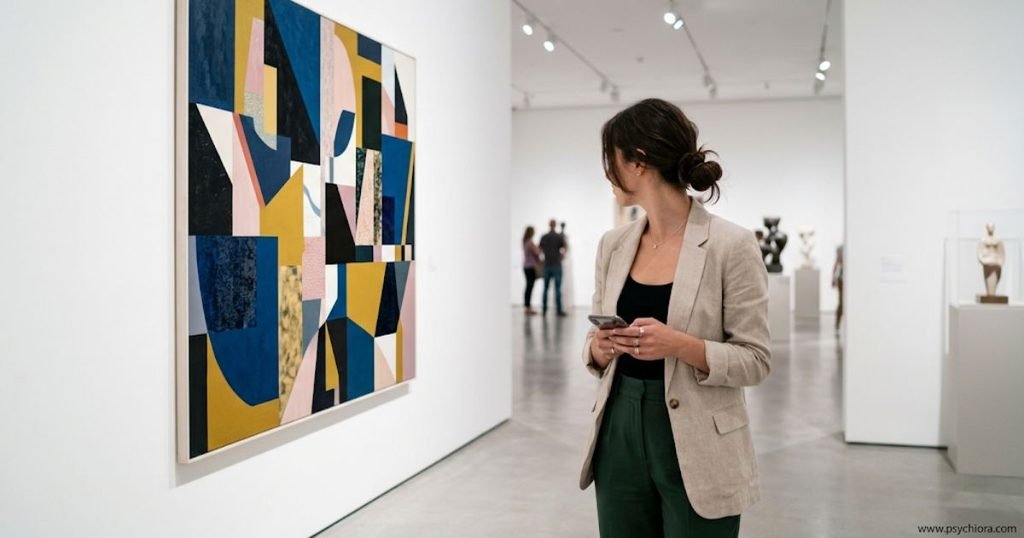
Clever captions do a little more work — a small twist, a pun, or a line that only makes sense once you connect it to the photo. They’re best saved for shots where there’s an obvious detail to play off of: a painting’s subject, a sculpture’s pose, or the sheer size of a room.
● I came, I saw, I overanalyzed the brushwork.
● Still life, but make it my life.
● Framed and famous (the painting, not me).
● I’m not lost, I’m “exploring the exhibit.”
● Old masters, new selfie.
● This painting has seen more drama than my group chat.
● Priceless art, price of admission: worth it.
● Gallery hopping, one hallway at a time.
● I paused. The painting made me.
● On brand: dramatic lighting, dramatic art.
● The statue and I are both standing here doing nothing.
● Currently rethinking my career as an artist.
● This portrait has been staring longer than I have.
● Chiaroscuro is just a fancy word for “moody lighting,” and I love it.
● Some of us peaked in the Renaissance.
● I’d frame this moment, but the museum already framed everything else.
● Sculpture: 0, my back after standing here for an hour: also 0.
● This is the only exhibit where being “still” is the whole point.
Save the pun-heavy lines for photos where the joke is visible — a caption about “brushwork” under a photo of an empty hallway won’t land the same way it will under an actual painting.
Funny Museum Captions
Funny captions work best on the photos that aren’t trying to be artistic — the ones where you’re pulling a face next to a statue, looking exhausted by hour three, or standing suspiciously close to a “do not touch” sign. These lean into the reality of a museum trip instead of the artsy version of it.
● My feet filed a complaint after hour two.
● I understood maybe 12% of the plaques.
● Pretending I know what “neoclassical” means.
● Me: I love art. Also me: skips every plaque.
● This statue and I have the same energy: blank stare, no movement.
● Came for culture, left with a gift shop magnet.
● I stood here for five minutes like it would help me understand modern art. It did not.
● 90% of this trip was me saying “wow” without knowing why.
● Museum legs are a real medical condition.
● I’ve made more eye contact with paintings today than with people this week.
● The audio guide narrated my entire personality crisis in the abstract art wing.
● Trying to look cultured while googling “what is this.”
● I read one description and now I’m basically a curator.
● This is the most I’ve walked without my phone telling me to stand up.
● Somewhere between “this is beautiful” and “my back hurts.”
● I came in for the dinosaurs and left with opinions about Baroque architecture.
These captions pair naturally with candid or slightly awkward photos — group shots, tired faces, or you next to something oddly specific like a taxidermy display or a suit of armor.
Aesthetic Museum Captions
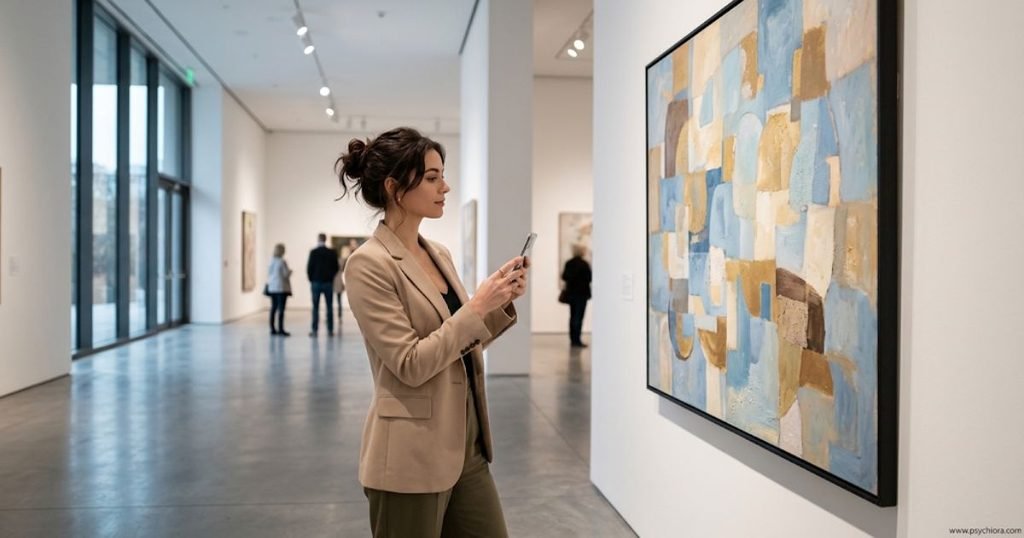
Aesthetic captions are quieter and more atmospheric — built for the kind of photo where the lighting, the marble floor, or the shadow of a doorway is doing most of the work. These skip jokes entirely and lean into mood.
● Soft light, older stories.
● Marble floors and quiet thoughts.
● Somewhere between then and now.
● Held still by something old.
● Colors that outlived their painters.
● A hallway full of borrowed time.
● Stillness, framed.
● Light finds its way even here.
● Textures older than language.
● A little dust, a lot of history.
● Golden frames, grey afternoons.
● The kind of quiet that isn’t empty.
● Everything here has already survived once.
● A room built to slow you down.
● Shadows longer than the stories behind them.
These lines tend to work best under close, deliberate shots — a single sculpture, a shaft of light through a window, a detail shot of a frame or texture — rather than busy group photos, where a quieter caption can feel out of place next to a crowded image.
One-Word Museum Captions
Sometimes a single word says more than a full sentence — especially under a photo that’s already visually strong enough to carry itself.
● Awestruck.
● Timeless.
● Wanderlust.
● Perspective.
● Stillness.
● Curated.
● Speechless.
● Iconic.
● Preserved.
● Enchanted.
● Grounded.
● Immersed.
One-word captions work best paired with a strong photo and a location tag — the caption sets the tone, and the tag fills in the “where,” so nothing feels missing.
Art Museum Captions
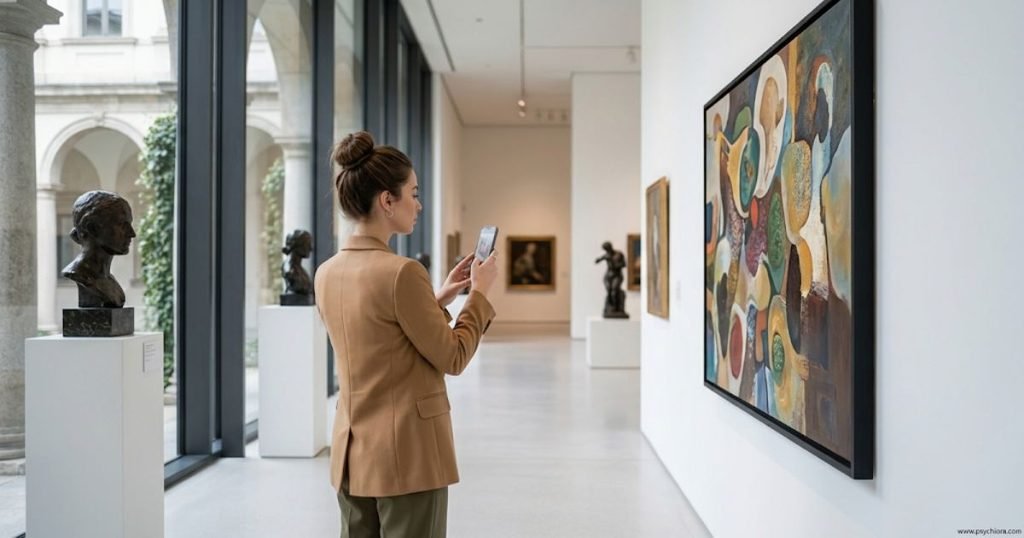
Art museums come with their own visual language — brushstrokes, frames, marble, color — and captions that lean into that specificity tend to feel more intentional than generic “museum day” lines.
Painting Captions
● Standing closer to this than the guard would like.
● Some paintings you look at. This one looked back.
● Proof that color can outlive everyone who ever saw it first.
● I don’t know art history, but I know I stood here for ten minutes.
● This canvas has more layers than my personality.
● A brushstroke that’s outlasted several empires.
Sculpture Captions
● Carved patience.
● This statue has better posture than I do.
● Marble doesn’t rush, and neither should you.
● Frozen mid-story, still telling it.
● Stone that’s outlived every person who touched it.
● Standing next to something that’s been standing longer than my entire family tree.
History Museum Captions
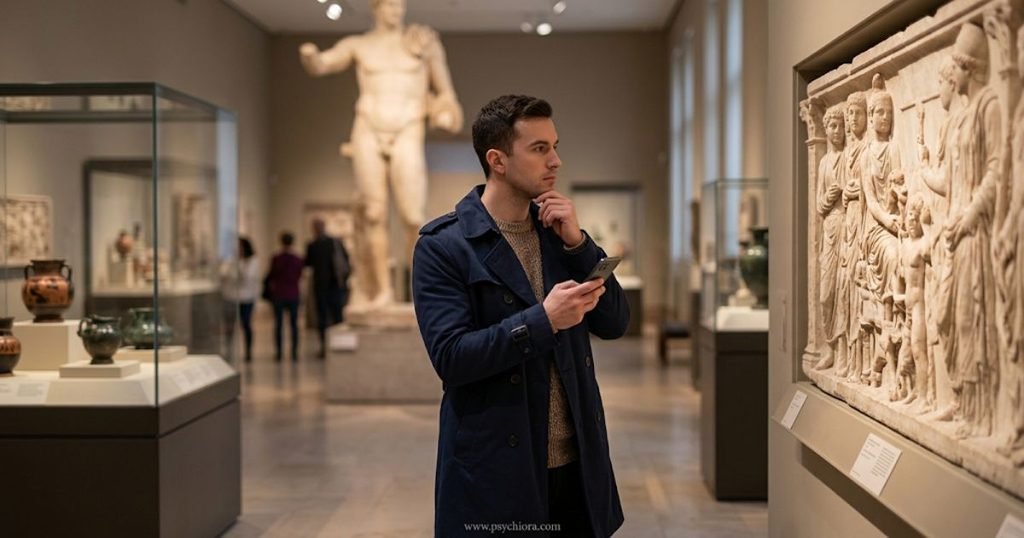
History museums call for a different tone than art galleries — less about color and brushwork, more about time, artifacts, and the strange feeling of standing near something genuinely old.
● Older than every argument I’ve ever had.
● This artifact has seen more history than my textbook covered.
● Standing where centuries collapse into one hallway.
● Proof that people have always been dramatic — just with worse plumbing.
● This display case holds more patience than I do in traffic.
● History, but make it something I can actually touch (through glass, obviously).
● Every exhibit here outdates my entire family tree.
● I came for the dinosaurs and left questioning my own timeline.
Museum Selfie Captions
Selfies at a museum are less about the art and more about you being there — so these captions lean into that self-aware, slightly funny energy rather than trying to sound artsy.
● Me, the art, and a healthy amount of confusion.
● Matching energy with a 300-year-old painting.
● Selfie game strong, art history knowledge weak.
● Just two masterpieces in this photo (one of them is old).
● Trying to look like I understand modern art.
● This is the closest I’ll ever get to being in a museum myself.
● Posing next to something that’s aged better than me.
● Selfie with my new favorite roommate (a statue, no complaints so far).
Real Museum & Art Quotes for Instagram
A lot of “museum quotes” circulating online are misattributed — lines pinned to Picasso, Da Vinci, or Einstein with no real source behind them. Here are quotes that are genuinely documented, along with honest notes where attribution is disputed.
● “I dream of painting and then I paint my dream.” — Vincent van Gogh, from his personal letters.
● “Art is not a handicraft, it is the transmission of feeling the artist has experienced.” — Leo Tolstoy, from his 1897 essay What Is Art?
● “I found I could say things with color and shapes that I couldn’t say any other way.” — Georgia O’Keeffe, from her own writings on her work.
● “A museum is a place where one should lose one’s head.” — Renzo Piano, architect of several major museum buildings, in an interview about museum design.
● “Art is what you can get away with.” — Often attributed to Andy Warhol, though the phrase is more reliably traced to media theorist Marshall McLuhan describing Warhol’s approach; use it as “often attributed to” rather than a confirmed Warhol quote.
● “The aim of art is to represent not the outward appearance of things, but their inward significance.” — Aristotle, from his writings on poetics, widely cited in art criticism.
If you want a quote for a caption, pairing a short, verified line like these with your own one-line reaction (“Van Gogh said it better than I ever could”) tends to feel more genuine than the quote alone.
Museum Photography Etiquette You Should Know Before Posting
Before your museum photos make it to Instagram, it’s worth knowing the rules most museums actually enforce — because getting stopped mid-shot is more common than most first-time visitors expect.
● Flash is almost always banned. Repeated flash exposure can damage pigments and delicate materials over time, so most museums prohibit it outright, even in rooms that otherwise allow photography.
● Not every exhibit allows photos. Loaned works, temporary exhibitions, and pieces under copyright restrictions are often off-limits for photography, even if the museum’s permanent collection allows it freely. Look for small signage near the entrance of each room.
● Selfie sticks and tripods are frequently restricted. Crowded galleries and fragile displays make extended equipment a hazard, so many museums ban them regardless of their general photo policy.
● “No touching” applies to more than the art. Frames, glass display cases, and pedestals are usually off-limits too, even for a quick lean-in photo.
● Staff will ask before you know you’ve done anything wrong. If you’re unsure whether a room allows photography, it’s faster (and less embarrassing) to ask a staff member than to find out mid-shot.
Knowing this before your visit means fewer interrupted moments — and it means the photos you do get were taken without a guard walking over mid-frame.
FAQ’s
What is a good caption for a museum picture?
A good caption matches the photo’s tone — short and punchy for wide shots, something specific about the artwork for close-ups, or a light joke for candid or selfie shots. The strongest captions reference something specific in the photo rather than a generic line that could fit any museum picture.
What do you caption a museum trip?
For a full trip recap or carousel post, a slightly reflective or funny short caption tends to work best, since it needs to cover multiple photos at once rather than one specific piece. Something like “A day, several centuries, zero regrets” covers a mixed set of photos naturally.
How do you caption an art gallery post?
Art gallery captions tend to work best when they reference the mood of the piece — color, stillness, scale — rather than a generic “art is cool” line. A short quote from a verified artist source also works well for gallery-specific posts.
What is a short quote about museums?
Architect Renzo Piano’s line, “A museum is a place where one should lose one’s head,” is a genuine, documented quote often used for museum-themed captions because it captures the feeling of being pleasantly overwhelmed by a collection.
What is a one-word caption for art?
Words like “Timeless,” “Speechless,” or “Curated” work well as one-word captions because they’re broad enough to fit most art photos while still sounding intentional rather than random.
Are museum selfies allowed?
Most museums allow selfies in general photography areas, but rules vary by exhibit — some temporary or loaned collections restrict all photography, including selfies. Checking posted signage or asking staff at the entrance is the most reliable way to know for sure.
Is flash photography allowed in museums?
Flash is banned in the vast majority of museums because repeated exposure can damage pigments, textiles, and other light-sensitive materials over time. This rule typically applies even in galleries where regular photography is otherwise permitted.
What’s a clever way to caption a painting photo?
Clever painting captions usually work by playing on something visible in the piece itself — its subject, its age, or an ironic contrast between the artwork and your own reaction to it — rather than a generic pun that could apply to any painting.
How long should an Instagram caption be for a museum post?
Short captions, generally under 15–20 words, tend to perform best for museum photos, since the image itself is usually the main draw. Longer captions work only when they’re adding real context, like a quote or a specific detail about the piece.
Conclusion
The best museum caption isn’t the longest or the most quote-heavy one — it’s the one that actually matches the photo it sits under. A wide hallway shot doesn’t need the same caption as a close-up of a 400-year-old painting, and a selfie next to a statue doesn’t need to sound like an art critic wrote it. Use the caption types above as a starting point, match the tone to what’s actually in the frame, and you’ll end up with a museum caption that feels like it belongs to your photo instead of one copy-pasted from a list of hundreds.

I create engaging, creative, and relatable captions for social media, helping readers express their thoughts, emotions, moments, and stories with the perfect words.